Brainstorm
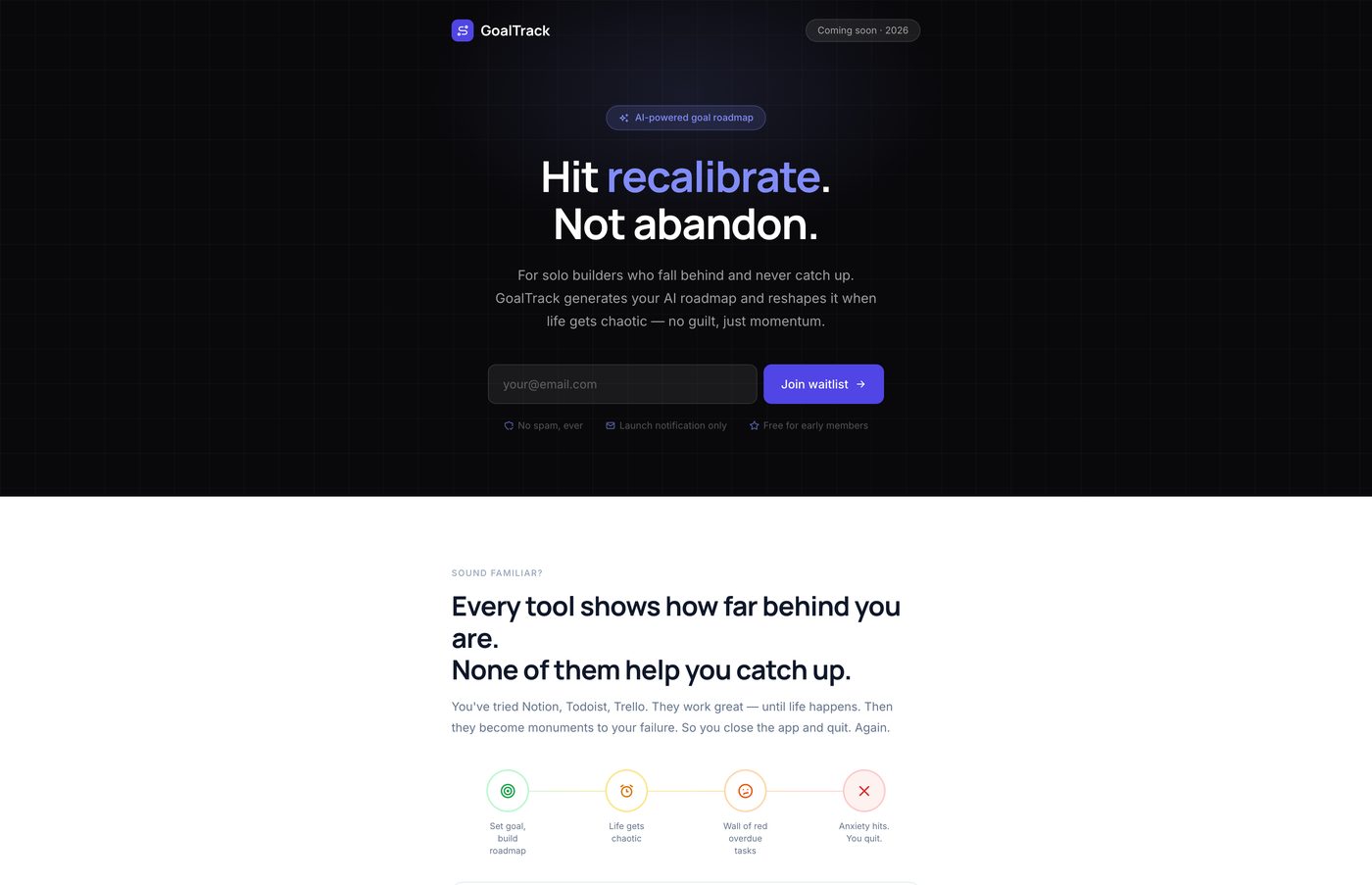
Every goal-tracking tool has the same failure mode: you fall two weeks behind, the app shows you a wall of overdue tasks in red, and closing the tab feels better than facing it. Notion, Todoist, and Trello are all fine at storing a plan — none of them do anything useful the moment reality stops matching it. GoalTrack’s premise is one sentence: recalibrate, don’t abandon.
Discovery
The target user is a solo builder with no manager, no team, and no external accountability system — someone whose only real risk isn’t a lack of planning tools, it’s the anxiety spiral of an overdue list with no way back in. That ruled out anything that looked like a project-management tool with swimlanes and story points; the product needed to feel like a private command centre, not another dashboard to fall behind on.
Design
The homepage runs a deliberate before/after comparison — the same two-weeks-late scenario shown two ways, once as a wall of red “overdue” tags with no path forward, once as a single “Recalibrate” action that reshapes the remaining timeline around today. That comparison is the entire pitch, so it sits above the fold instead of in a features list further down the page.
Build
The flow is intentionally short: describe a goal in plain language (“Launch MVP in 45 days, I know JavaScript but need to learn Next.js”), get an AI-generated phased roadmap back in under 30 seconds, then report progress with one of three states — On track, Slow, Stuck — rather than checking off granular subtasks. Recalibrate is the one feature that does real work: when triggered, it re-sequences the remaining roadmap around the user’s actual current position instead of just re-dating a static list.
Delivery
Currently pre-launch — a waitlist landing page validating the recalibrate concept ahead of a 2026 build-out.