Brainstorm
Most “best of” product roundups are SEO filler: generic specs copied from a manufacturer page, no real opinion, and an Amazon link at the end. Priviw’s premise was to do the opposite in a narrow lane — pick a small, genuinely curated set of workspace and tech products, write an honest “best for” line for each, and be upfront that it earns a commission on the links out. Fewer products, more trust per product.
Discovery
The audience is a specific buyer, not a general shopper: remote software engineers, designers, and knowledge workers outfitting a home office, who’d rather read four honest bullet points than a 2,000-word review. Region mattered as much as product — the same buyer in India and the US sees completely different pricing and availability, so the storefront needed live, region-aware pricing rather than a single global price list.
Design
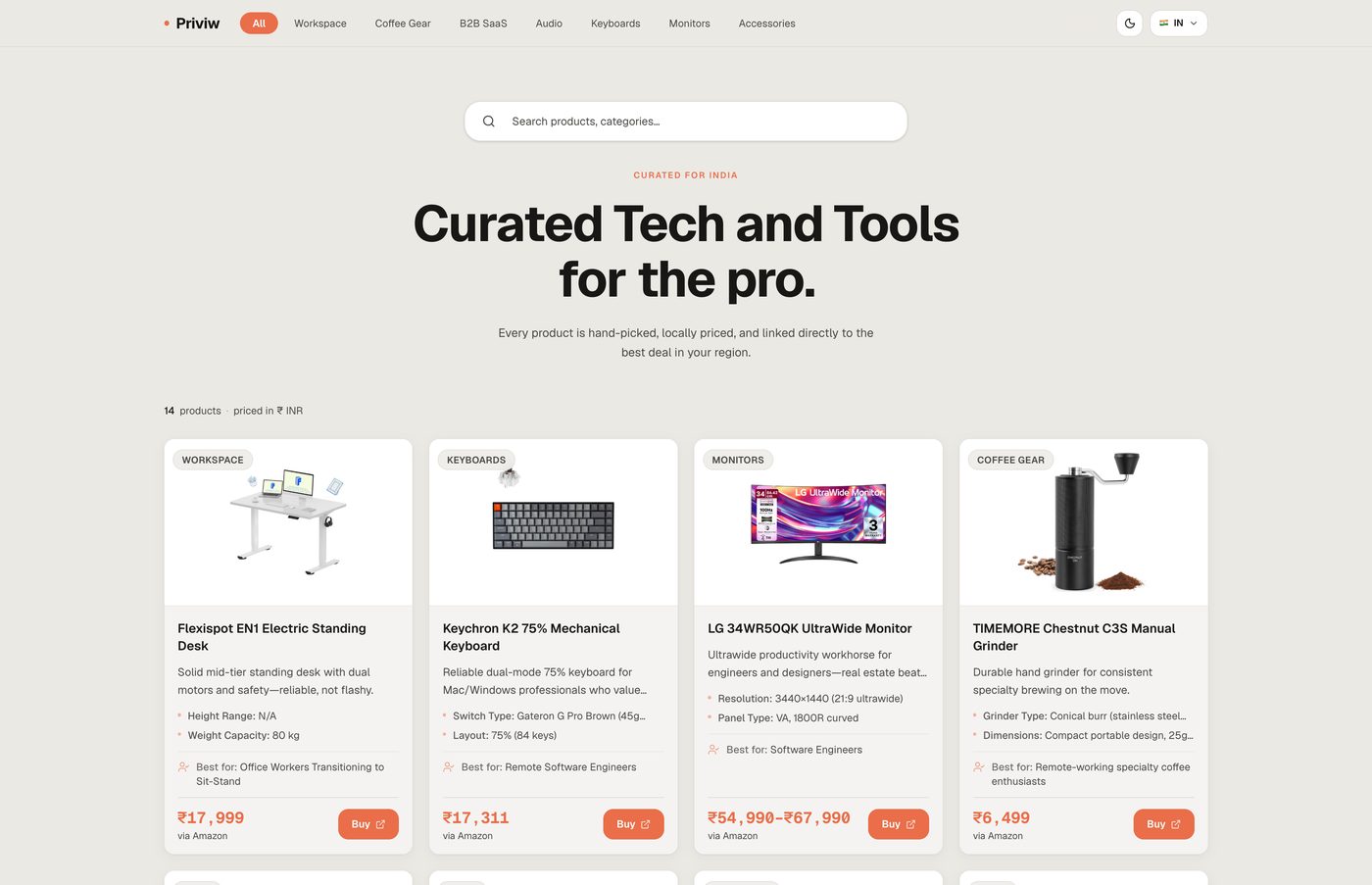
Each product card leads with a category tag, a real spec bullet or two, and a “Best for” line naming a specific persona (Remote Managers, Software Engineers, Field Engineers) rather than a generic “great for everyone.” That’s a deliberate editorial constraint: if a product doesn’t have a specific person it’s best for, it doesn’t earn a card. A currency/region switcher in the header keeps pricing honest without forking the whole site into two builds.
Build
Product data — price, specs, “best for,” and the outbound affiliate link — is content-driven rather than hardcoded per card, which is what made it possible to stand up a second storefront (Fabluz, in luxury fashion) on the same system without rebuilding the template. The catalog currently spans workspace, audio, keyboards, monitors, coffee gear, and accessories, each with a live price pulled at request time rather than a stale cached number.
Delivery
Live with a 14-product catalog across six categories, region-aware pricing, and outbound affiliate tracking.